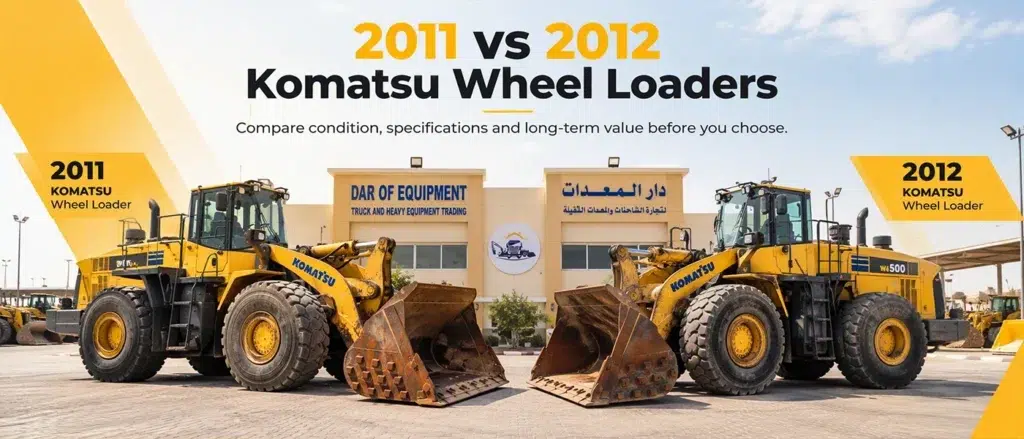
Most buyers start with price. They search for a second hand wheel loader, sort the listings from cheapest to dearest, and ring the first few.
That’s backwards. The cheapest loader is rarely the cheapest to own. A machine that’s too small for your material, or one with a tired articulation joint and a set of worn tyres, can cost you more in downtime in six months than a better unit would have cost upfront.
Choosing a used wheel loader comes down to four things. Match the machine to the job, read its true condition rather than its hour meter, work out what it will cost to run, and buy from someone who will stand behind it. This guide takes those in order.
Start With the Work, Not the Machine
A wheel loader is a bucket on a pivoting frame. What separates a good purchase from a bad one is how well the bucket, lift height and weight suit your daily material and site.
The quick answer: choose by what you move and how high you need to lift it. Small, tight yards suit a compact loader. Aggregate, quarry and port stockpiles suit large machines.
| Typical application | Suggested class | What to look for |
|---|---|---|
| Landscaping, nurseries, small yards, farms | Compact wheel loader | Tight turning, light ground pressure, attachment compatibility |
| Building supply, ready-mix plants, general construction | Small to mid-size loader | Balanced bucket size, good visibility, easy servicing |
| Aggregate yards, asphalt plants, recycling | Mid-size to large loader | Higher tipping load, strong cooling, durable bucket |
| Quarries, mining support, bulk ports | Large loader (25–30 tonne class and above), such as the Komatsu WA500-6 | Heavy-duty axles, tyre life, robust structures |
Two details catch buyers out.
Material density matters more than bucket volume. A 3 m³ bucket of dry sand is a very different load from 3 m³ of wet gravel or crushed rock. Ask a dealer for the machine’s rated tipping load and work backwards from your heaviest material.
Height and reach decide whether a truck gets loaded cleanly. Check the dump clearance against the tallest tipper or hopper you serve. It’s a basic check, and it’s skipped surprisingly often.
If you’re searching for a compact wheel loader for sale, be clear about why you want compact. If it’s for access and manoeuvrability, great. If it’s only because the price is lower, you may be buying a machine you will outgrow within a season.
New Operators of Used Machines: Which Brands and Models Hold Up?
Caterpillar, Komatsu, Volvo, CASE, and JCB dominate the used market for a reason. Parts support, technician familiarity and resale value are strong, and that matters when a machine is working in a hot, dusty region.
Within a brand, popular models are easier to find parts for, easier to service and easier to resell later. A Komatsu WA500-6 or a CAT 980, for example, are large, well-supported machines that suit heavy aggregate and stockpile work. A machine with a smaller following may be cheaper, but you can pay the difference back in parts lead times.
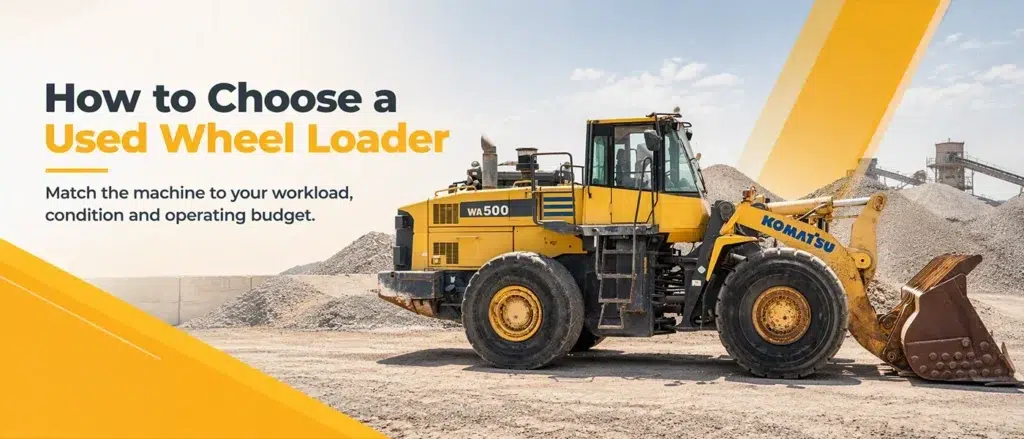
The Komatsu WA500-6 is a large, well-supported loader for quarry, aggregate and stockpile work.
See Used Wheel Loaders in Stock in Dubai
Browse inspected Komatsu and CAT wheel loaders at Dar of Equipment, with model year, brand and specifications on each listing.
What Does a Used Wheel Loader Cost?
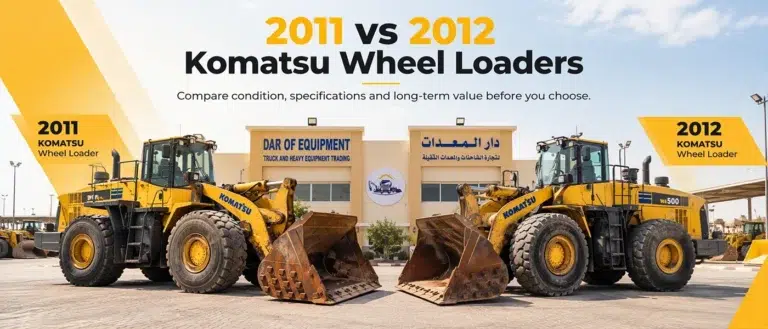
People often search for a Komatsu wheel loader price expecting one number. There isn’t one, and any listing that implies otherwise should make you cautious. For a live example of how listings differ by year, compare the 2012 Komatsu WA500-6 with the 2011 Komatsu WA500-6.
Price is driven by:
- Size class and model. A 5 m³ loader and a 1.2 m³ loader live in different price brackets entirely.
- Model year and hours. Both matter, but neither tells the full story on its own.
- Maintenance history. A documented service record can justify a higher price, and an undocumented one should lower it.
- Tyre condition. On a large loader, a fresh set of tyres is a major expense.
- Specification. Air conditioning, ride control, a weighing system or a quick coupler all add value.
- Origin and market. Where the machine has worked, and where it’s being sold, both shift the number.
A fair way to compare is to price the whole first year: purchase price, immediate repairs, tyres, fluids, transport and any commissioning work. The loader that looks cheaper can easily finish second on that measure. If you’re weighing used against new, our article on why a used wheel loader could be the smarter investment covers the cost difference in more detail.
Reading a Machine’s Real Condition
Hours are a useful starting point, but they can be misleading. A loader with 9,000 hours spent loading sand in an easy yard may be in far better shape than one with 6,000 hours spent in a quarry. The way the machine was used and maintained counts for more than the number on the dial.
The walk-around inspection
Start with the structure and the wear points, because these are the expensive ones.
- Articulation joint. Look for play in the pins and bushings, as well as checking for cracks or weld repairs around the pivot area. Excessive movement here is a major warning sign.
- Lift arms and bucket linkage. Check the pins and bushings for wear and look for fresh paint hiding repairs.
- Bucket and cutting edge. A worn edge is normal and cheap to replace. A cracked or heavily patched bucket is not.
- Tyres. Look for cuts, uneven wear and sidewall damage. Uneven wear can also point to axle or alignment trouble.
- Hydraulic cylinders and hoses. Chrome rods should be smooth, with no pitting. Wet cylinder seals and weeping hoses suggest costly work ahead.
- Engine bay. Look for leaks, loose wiring and signs of overheating. Check the radiator and cooler cores for blockage or damage.
- Cab. Working air conditioning, intact seat and controls and a sound ROPS/FOPS structure matter more than you’d think, especially in hot climates where operators work long shifts.
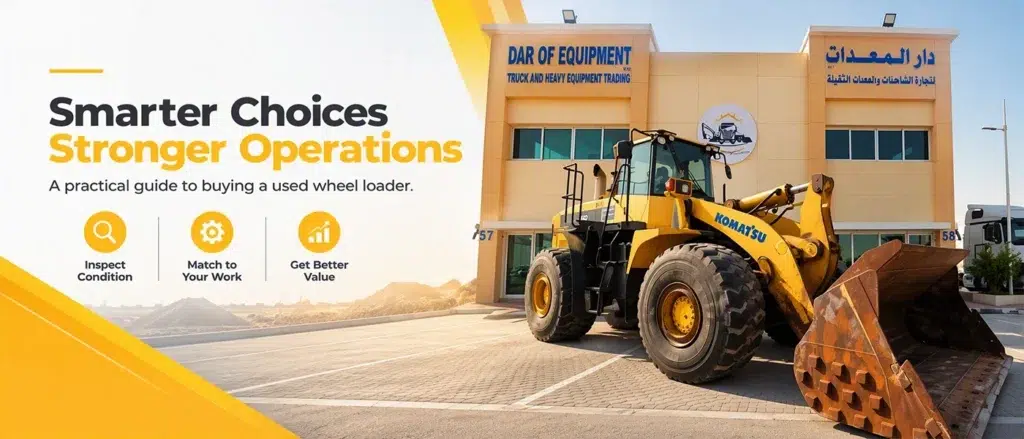
Start the walk-around with the structure and wear points. These are the expensive ones.
The operating test
Always see the machine run, ideally under load.
- Cold start: it should fire cleanly without heavy smoke.
- Transmission: shifts should be smooth in both directions with no slipping or harsh engagement.
- Steering: it should track straight and respond evenly left and right.
- Lift and tilt: movement should be steady, with no judder and little drift when held.
- Brakes: test them thoroughly, not gently.
- Temperatures and warnings: let it work for at least 20–30 minutes and watch the gauges and warning lights.
Paperwork worth asking for
- Service and repair history
- Proof of ownership and the serial number, matched to the machine
- Any oil analysis records
- Details of recent major component replacements
Expert tip: If a seller can’t tell you how the machine was used, treat that as information. Good operators and good fleets keep records. Gaps in the history are a reason to inspect harder or negotiate.
Red Flags That Should Slow You Down
| What you see | What it may mean |
|---|---|
| Fresh paint on structural areas only | Cosmetic cover-up of repairs |
| Unusually clean engine bay on an old machine | Recent wash to hide leaks |
| Hour meter that doesn’t match general wear | Meter replaced or tampered with |
| Reluctance to allow a test under load | A fault that only shows under pressure |
| Mismatched or very worn tyres | Deferred maintenance or axle issues |
| Price far below comparable machines | Hidden problems, or a seller who can’t back the sale |
Mistakes We See Buyers Make
- Buying on hours alone. A low-hour machine with a poor history can be riskier than a higher-hour one that’s been looked after.
- Ignoring tyres. On big loaders, tyres are one of the largest running costs. Budget for them.
- Skipping an independent check. Even if you trust the seller, a second pair of experienced eyes is cheap insurance.
- Forgetting about parts and support. A good price means little if you wait weeks for a common component.
- Buying too small to save money. Running a loader at its limit every day shortens its life and slows your operation.
Why Buy From a Specialist Rather Than Searching Listings
Searching for used wheel loaders for sale online will throw up hundreds of results, but listings don’t tell you what a machine has been through. Buying through a dealer who inspects equipment before it’s offered, and who can explain what they found, takes much of the risk out.
At Dar of Equipment, we supply quality used construction equipment from leading global brands including Caterpillar, Komatsu, Volvo and JCB. Our team offers expert consultation, so you can match a loader to your application before you commit, rather than after. If the machine you need isn’t in stock, we can source it for you.
Need other machines alongside your loader? Browse our used excavators, used bulldozers, used trucks and material handling equipment.
Your Next Step
Choosing the right used wheel loader is easier when someone who knows the machines helps you narrow the field. Tell us what you move, how much and where, and we’ll recommend loaders that fit the work and your budget.
Browse our current wheel loaders for sale or get in touch directly:
Call: +971 4 832 1114
or +971 50 336 3519,
Email: info@darofequipment.com
Frequently Asked Questions
For most small operations such as yards, nurseries and small construction firms, a compact or small wheel loader is enough. Size it to your heaviest regular material and the height of the trucks you load, not to the largest job you might ever do.
There’s no fixed limit. Many well-maintained wheel loaders keep working past 10,000 hours, and some well beyond that. Maintenance history, the work the machine has done and the condition of major components matter more than hours alone.
It depends on the model, year, hours, condition and specification, so there’s no single price. Contact a dealer with your required size and budget. Compare quotes on a like-for-like basis, including tyres and any repairs needed.
If you need a loader for a few weeks, rent. If you’ll use it regularly across months or years, buying used usually works out cheaper. Many businesses rent first to confirm the right size, then buy.
Check the articulation joint, lift arm pins, tyres, hydraulic cylinders, engine bay, cab and service records, and always test the machine under load. A thorough inspection catches the expensive problems early.
Yes, and you should. A reputable dealer will welcome an inspection and be open about the machine’s history. Be wary of any seller who resists it.
They can be, if the cooling system, air filtration and hydraulics have been well maintained. Check radiators and filters carefully, and confirm the air conditioning works.
Related reading