
A buyer once showed me two trucks side by side. Same make, same year, same 640,000 km on the dash. One had a tired engine that smoked on a hard pull. The other would happily do another 600,000 km. The odometer told him nothing about which was which.
That’s the trap when you shop for used trucks for sale. Mileage is the number everyone looks at, and it’s one of the weakest indicators of what’s left in the engine, it only tells you what it’s already done. This guide walks through how experienced buyers and technicians estimate remaining engine life, in the order they actually do it.
The short answer
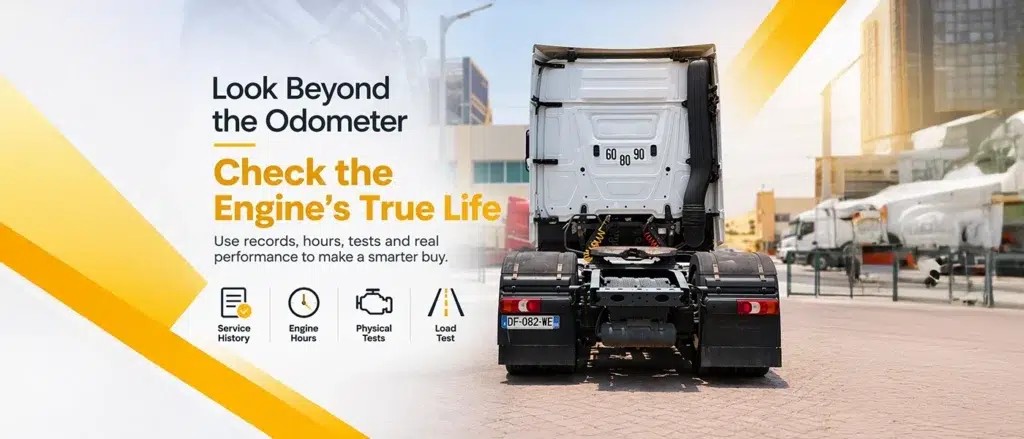
You can’t put an exact figure on remaining engine life, but you can build a reliable estimate. Combine four things: the service history, the engine’s operating hours and duty cycle, physical condition tests (compression, blow-by, oil analysis) and a loaded road test. Where those four agree, you can trust the estimate. Where they disagree, you have found the risk.
Myth: ‘Low mileage means plenty of life left’
Mileage counts distance, not work. A tipper idling on a quarry site or a truck crawling through port queues in Jebel Ali can rack up thousands of engine hours that barely move the odometer. A long-haul tractor unit running steady highway speeds covers huge distances with far less wear per kilometre.
Compare these two trucks:
| Truck A | Truck B | |
| Odometer | 480,000 km | 780,000 km |
| Duty | Construction, stop-start, long idling | Steady long-haul |
| Service record | Gaps, extended intervals | Full dealer history |
| Likely engine condition | Heavier wear than mileage suggests | Often better than mileage suggests |
Truck B is usually the safer buy despite the bigger number. This is why a serious assessment starts with how the truck was used, not how far it went.
Step 1: Read the service history before touching the truck
Paperwork is the cheapest inspection you will ever do. If available, ask for:
- Oil and filter change records, with dates and mileage or hours
- Coolant service and any overheating events
- Fuel filter and air filter replacement
- Previous engine work, such as injectors, turbo, head gasket or an in-frame overhaul
- Any warning lights or fault codes logged by the previous operator
A truck that has had its oil changed on schedule with the correct grade has a head start. Look for patterns. Regular intervals suggest an owner who cared. Long gaps followed by a sudden burst of work suggest someone preparing the truck for sale.
For modern Mercedes-Benz and Scania engines, ask whether the dealer can pull a service and fault history from the vehicle’s control units. Many fleet-maintained trucks have this, and it often reveals more than the paper file.
Step 2: Convert hours and duty cycle into a realistic picture
Engine hours are often a better wear measure than kilometres. A rough, widely used rule of thumb is that one hour of operation equals about 40 to 50 km of highway driving at average speeds. It is only a guide, but it helps you sense-check an odometer. If a truck shows 400,000 km and 14,000 hours, the engine has worked far harder than the distance suggests.
Think about the application too:
- Long-haul and highway: lowest wear per hour, steady temperatures
- Distribution and urban delivery: frequent starts, partial warm-ups, more wear on the bottom end
- Construction and tipping: heavy loads, dust, high idling hours. See our used tipper trucks and dump trucks
- Heavy machinery transport and low-loader work: sustained high load, so cooling and turbo health matter
Matching the engine’s previous duty to your own intended use is one of the most useful judgements you can make. A used heavy truck that has lived an easy life can be an excellent choice for harder work, as long as you know what you are starting with.
Want a Second Opinion on a Truck’s Engine?
Tell us which truck you are considering and what it will be used for. Our team will give you a straight view on whether the engine suits the work.

Step 3: Test the engine’s physical condition
This is where estimates become evidence. A good used equipment dealer shouldn’t have any issues with you bringing a mechanic to check over the truck prior to purchase.
Cold start behaviour. Always see the engine start cold. Hard starting, excessive white or blue smoke, or a rough idle that settles only once warm all point to wear or injector problems. A warm engine can hide a lot.
Blow-by check. Combustion gases leaking past worn piston rings pressurise the crankcase. Excessive breather smoke or a measurable blow-by reading suggests ring and liner wear, and that is a common sign an engine is entering the final third of its life.
Compression or cylinder balance. Where a direct compression test isn’t practical on a diesel, technicians use cylinder contribution tests through the diagnostic software. A cylinder that lags behind the others deserves investigation.
Coolant and cooling system. Check for oil in the coolant, pressurisation of the system and radiator condition. In UAE summer temperatures, a marginal cooling system can destroy an otherwise healthy engine, so it matters more here than in cooler climates.
Turbocharger and boost. Shaft play, oil leaks around the turbo and low boost under load all show up in testing. A failing turbo is a repairable cost, but it can also be a symptom of oil or air filtration neglect that affected the whole engine.
Exhaust and emissions system. Particulate filter or SCR problems can mask or mimic engine issues. Fault codes here should be understood before you buy, not after.
Step 4: Put it under load
An unloaded test drive proves very little. If possible, drive the truck loaded or on a hill. Watch for:
- Power that fades or surges under load
- Temperature climbing steadily rather than stabilising
- Black smoke on acceleration, or blue smoke on overrun
- Unusual knocks, whines or injector ticking
- Oil pressure that drops noticeably at hot idle
An engine that pulls strongly, holds temperature and keeps oil pressure steady under load is telling you something no brochure can.
A practical way to score what you find
Technicians rarely give a single number. A simple scoring approach works well for buyers comparing several trucks:
| Evidence | Good | Caution | Poor |
| Service history | Complete, on schedule | Partial | None or irregular |
| Hours vs km ratio | Consistent with duty | Slightly high | Very high |
| Oil analysis | Clean | Slightly elevated metals | Coolant, fuel or heavy wear metals |
| Blow-by | Minimal | Moderate | Heavy |
| Load test | Strong, stable | Minor issues | Fading, overheating, smoking |
Mostly ‘good’ suggests a long remaining life, often a very substantial share of a well-maintained commercial diesel’s working lifespan. A mix of ‘caution’ results suggests budgeting for a mid-life overhaul within a couple of years. Several ‘poor’ results mean you are really buying a rebuild project, and the price should reflect that.

What engine life realistically looks like
Well-maintained modern heavy diesels from established manufacturers often reach 1,000,000 km or more before a major overhaul, and many keep going with in-frame work. That figure depends heavily on maintenance, load, operating environment and fuel quality, so treat it as a ceiling to compare against rather than a promise.
This is part of why well-known brands such as used Mercedes trucks and used Scania trucks hold their value in the Gulf market. Their engines are well understood, parts and technical knowledge are widely available, and a good example with documented history can offer many years of reliable work. That doesn’t remove the need to inspect. It just means a well-chosen engine is worth the diligence.
Mistakes that cost buyers money
- Trusting the odometer alone. Verify against hours, wear and records.
- Inspecting a warm engine. Cold starts reveal problems warm engines hide.
- Ignoring the cooling system in a hot climate.
- Not matching the truck to the job. A light-duty history is not proof of heavy-duty readiness.
- Buying purely on price. A cheap truck with a doomed engine becomes the most expensive one you own.
Getting an independent opinion
If you’re buying used trucks for sale in the UAE, especially at higher value, an expert second opinion pays for itself quickly. Ideally the inspection is done by someone with no interest in the sale, or by a supplier who is willing to show you the evidence rather than just describe it.
Dar of Equipment supplies quality used equipment across the commercial vehicle range, including used heavy trucks for sale in Dubai and wider UAE markets. The team offers expert consultation on matching a truck’s engine condition to your application, whether that is long-haul, construction or heavy machinery transport. Bringing the intended use into the conversation early helps avoid buying a truck that is technically sound but wrong for the work.
Your Next Step
Estimating remaining engine life is less about one clever test and more about layering evidence until the picture is clear. Start with records, understand the duty cycle, test the physical condition and confirm it under load.
If you’re comparing used trucks for sale and want a straight opinion on a particular engine, speak to the Dar of Equipment team. You can browse the current range at Commercial Vehicles and request expert consultation on any truck before you commit.
Request Expert Advice on a Used Truck
Send us the truck you are considering and your intended use. We will help you judge the engine before you commit.
Explore:
Frequently Asked Questions
Many well-maintained heavy diesel engines can exceed 1,000,000 km before a major overhaul. Real life depends on maintenance, load and duty cycle, so condition matters more than any single figure.
Hours often reveal more, particularly for trucks that spend time idling or working on site. Use both together. A large mismatch between hours and distance tells you how hard the truck has worked.
No single test is enough, combine a blow-by check, cold start observation and a loaded road test, to get the most information you can prior to purchase.
You can spot obvious warning signs: smoke, oil leaks, rough idle, overheating. For a purchase decision, a qualified technician with diagnostic equipment is worth paying for.
Both have strong reputations for durability when properly serviced. Their condition still depends on history and use, so assess each truck on its own evidence.
Heavy blow-by, rising oil consumption, persistent smoke, coolant in the oil, low oil pressure when hot and loss of power under load all suggest major work is approaching.
It varies widely by engine and scope, from in-frame work to a full rebuild. Get a quote for the specific engine before you buy, then weigh it against the truck’s price.