Picture a buyer who drives four hours to see an excavator advertised as “low hours, ready to work.” The paint is fresh and the cab is spotless. The hour meter reads 3,100. Then he notices the pedal rubbers are worn smooth, the bucket pins rattle, and the operator’s seat has collapsed on one side. That machine has not done 3,100 hours. It has done a lot more, and someone hoped he would not look closely.
Buying used construction machinery can save serious money, but only if you inspect it properly and go through a reputable dealer. This checklist works for any machine, from excavators and loaders to dozers, telehandlers, rollers and dump trucks.
The Short Answer: What to Check, in Order
If you only remember one sequence, use this one:
- Paperwork and service history
- Walk-around of the structure, welds and paint
- Cold start and engine health
- Hydraulic system
- Undercarriage, tyres and wear parts
- Controls, cab and safety systems
- Working test under load
- Independent inspection for high-value purchases
Do it in that order. Paperwork first, because it tells you what to look for. Cold start before any warm-up, because a warm engine can hide problems.
Start With the Paperwork, Not the Paint
A machine’s records tell you more than its appearance. Ask for:
- Proof of ownership. The seller should be able to show clear title, with no finance or lien outstanding.
- Serial number match. Check the plate on the machine against the documents and any stamped numbers on the frame.
- Service records. Regular oil, filter and hydraulic fluid changes matter more than a recent respray.
- Inspection and compliance certificates. Lifting equipment such as cranes and telehandlers needs valid thorough-examination records under the rules in your country.
- Hour meter history. Compare the reading with service intervals. If the records stop at 2,000 hours and the meter says 3,400, ask why.
Gaps are not automatically deal-breakers. A seller who cannot explain them is a different matter.
The Walk-Around: Reading the Machine’s Story
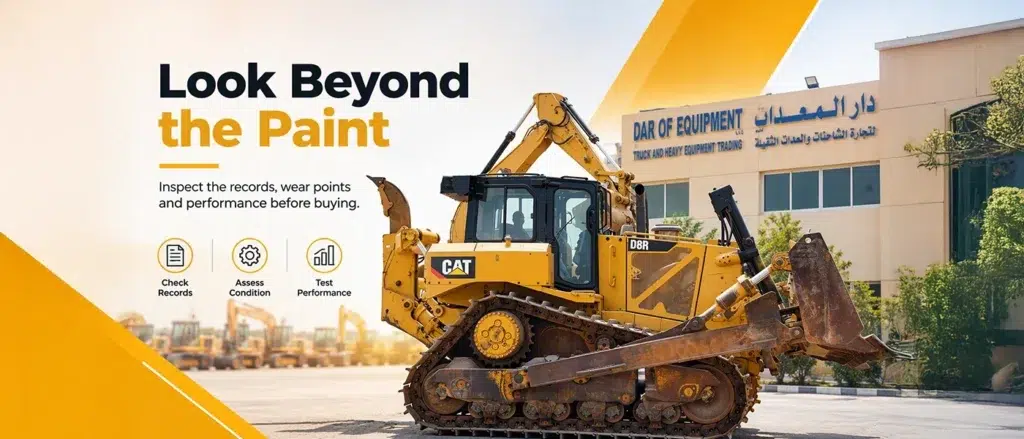
Walk the whole machine slowly before touching anything. You are looking for wear that does not match the hours.
Paint and body. Fresh paint on part of a machine can hide weld repairs or leaks. Look for overspray on rubber seals, hoses and decals.
Structure and welds. Check booms, sticks, loader arms, chassis rails and pivot points for cracks, patch plates and uneven weld beads. Factory welds are neat and consistent. Rough welds near stress points suggest past damage or overloading.
Pins and bushings. Grip the bucket, arm or attachment and try to move it. Visible play means worn pins or bushings and replacing them adds up quickly.
Leaks. Check under the machine, around cylinder rods, hose fittings, final drives and the engine. A little weeping is normal on older equipment. Active drips are not.
Wear versus hours. Compare the pedals, steering wheel or joysticks, seat and handrails against the hour meter. Heavy wear on a “low hour” machine is the classic warning sign.
What to Prioritise on Different Machine Types
Every machine has its own weak points. This table covers the most common categories of heavy construction equipment.
| Machine | Check first | Typical problem areas |
| Excavator | Undercarriage, swing bearing, boom and stick welds | Worn track chains, swing play, cracked boom, hydraulic leaks |
| Wheel loader | Articulation joint, tyres, bucket edges | Worn pivot pins, uneven tyre wear, transmission slip |
| Bulldozer | Undercarriage, blade pins, final drives | Stretched tracks, worn sprockets, cracked blade frame |
| Telehandler | Boom wear pads, load charts, safety systems | Boom extension play, faulty load sensors, expired certificates |
| Articulated dump truck | Articulation, hoist cylinders, brakes | Frame cracks, worn brakes, body floor damage |
| Roller / compactor | Drum surface, vibration system, scrapers | Drum scoring, weak vibration, bearing noise |
For a deeper look at two of the most commonly bought categories, see our guides on how to choose a used wheel loader and our buyer’s guide to used wheeled excavators in Dubai, both of which go deeper into the inspection points specific to those machine types.
The Cold Start Test
Insist on starting the machine cold. If the engine is already warm when you arrive, the seller may possibly be hiding hard starting, smoke or noise.
Watch and listen for:
- Exhaust smoke at start-up. White smoke that clears quickly is usually normal. Blue smoke suggests burning oil. Persistent black smoke could point to fuel or air problems.
- Knocking, ticking or rattling. A healthy diesel has a steady rhythm. Irregular noises need explaining.
- Oil pressure and temperature gauges. Pressure should come up quickly and stay stable. Temperature should rise steadily without spiking.
- Warning lights. Check that every light comes on at ignition and goes off as it should. A dashboard where bulbs have been removed is suspicious.
- Fluids. Check engine oil, coolant and hydraulic oil. Milky oil can indicate coolant contamination. Dark, gritty or metallic hydraulic oil points to internal wear.
If you are not confident reading an engine, this is where expert consultation pays for itself.
Hydraulics: The Expensive Part
Hydraulic repairs can quickly erase any saving on the purchase price. Once the engine is warm, test every function.
- Cycle each cylinder fully in and out. Movement should be smooth with no jerking or hesitation.
- Listen for whining from the pump, which can indicate wear or aeration.
- Check cylinder rods for scoring, pitting or leaking seals.
- Time the cycles. Slow response when the oil is warm suggests worn pumps or valves.
- Hold a load, or the bucket at height, and watch for drift. A boom that sinks on its own has internal leakage.
- Inspect hoses for cracking, bulging and rubbing, and check fittings for corrosion.
Ask when the hydraulic filters and oil were last changed. Contaminated hydraulic oil quietly destroys pumps and motors.
Undercarriage, Tyres and Wear Parts
On tracked machines, the undercarriage can account for a large share of lifetime running costs. Measure it rather than guessing.
- Track chain stretch. Excessive slack, or tracks that can no longer be adjusted properly, mean the chain is at the end of its life.
- Sprockets and rollers. Pointed, hooked or shiny worn teeth show heavy wear. Rollers should turn freely without leaking.
- Track pads or shoes. Look at grouser height and for cracks or missing bolts.
On wheeled machines, check tyre tread, sidewall cuts and uneven wear patterns, which can point to alignment or axle problems. A mismatched set of tyres is a sign of cost-cutting.
Also inspect cutting edges, teeth, bucket liners and attachments. They are consumable, but badly worn ones suggest hard, abrasive work, and you should price replacements into your offer.
Controls, Cab and Safety Systems
The cab tells you how the machine has been treated and whether it is safe to operate.
- Test all joysticks, pedals, switches and levers for smooth, positive movement.
- Check the seat belt, ROPS/FOPS structure, mirrors, cameras, lights, horn and any alarms.
- Make sure parking brakes and service brakes hold on a slope.
- Confirm that load moment indicators, overload warnings and emergency stops work, where fitted.
- Check air conditioning, heater and glass if operators will spend long days in the cab.
Missing or bypassed safety devices are a deal-breaker, not a negotiating point.
The Working Test: Put It Under Load
A machine can idle perfectly and still fail when worked. Ask the seller to let you, or a competent operator, run it properly.
Dig, lift, travel, swing and brake. Take it up a slope. Run the attachments. Watch for loss of power, overheating, transmission slip, odd vibrations or warning lights appearing as the machine warms up. After the test, shut it down and recheck for leaks, as problems often show once the system has been under pressure.
If the seller will not allow a proper working test, ask yourself what they are protecting.
Red Flags That Should Make You Walk Away
- Seller refuses a cold start or working test
- Mismatched serial numbers or missing documents
- Fresh paint over cracked or repaired structure
- Hour meter that does not match the wear
- Pressure-washed engine bay with no service history
- Pressure to decide quickly or pay a deposit before inspection
- Bypassed safety systems
Matching the Machine to the Job
A flawless inspection does not help if you bought the wrong machine. Before you view anything, define the application. A 20-tonne excavator that handles bulk digging on a civil site is very different from a compact machine working in tight urban access. Consider:
- Ground conditions and access
- Lifting height, reach and load requirements
- Daily operating hours and attachment demands
- Transport and site restrictions
Many buyers also benefit from asking whether buying is the right route at all. If a project is short, a rental may beat ownership. If you need a machine for a particular phase or you are testing a new type of work, renting first can show whether a purchase makes sense. If your shortlist includes telehandlers or forklifts rather than earthmoving machines, the same inspection logic applies to our material handling equipment range, and if you’re also comparing used trucks for haulage, the paperwork and walk-around steps carry over directly.
Mistakes Buyers Make Most Often
Trusting the hour meter alone. Meters can be wrong or at the wrong dealership tampered with. Condition tells the real story.
Skipping the independent check. On higher-value equipment, a mechanic’s inspection or fluid analysis costs little compared with the risk.
Ignoring running costs. A cheap machine with a worn undercarriage can cost more than a better one at a higher price.
Forgetting parts and support. Check that parts are available and that there is service support for the brand and model.
Not budgeting for transport and immediate maintenance. Include these in your total cost from the start.
How Dar of Equipment Can Help
Inspecting a machine yourself helps, but a second pair of expert eyes changes the odds. At Dar of Equipment, we help buyers find quality used equipment across the range, from excavators and loaders to compactors and cranes, and we explain the condition of each machine honestly so you can decide with confidence.
Our team offers expert consultation on matching a machine to your application, on what a fair price looks like, and on whether rental possibilities make more sense for your project. If you are looking for heavy construction equipment for sale, we can guide you through what to inspect on the specific machine you are considering.
Ready to Buy Used Construction Machinery with Confidence?
A good inspection is simple in principle: check the records, read the wear, test the machine cold and under load, and walk away from anything that does not add up. If you would like expert backing, Dar of Equipment can help you find the right machine and check it with you.
Visit www.darofequipment.com to browse construction machinery for sale, ask about buying used heavy equipment for your specific application, or talk to our team about rental options before you commit.
Browse Construction Machinery for Sale
Browse Material Handling Equipment
- 📞 Phone: 04 832 1114 or +971 50 336 3519
- 📧 Email: info@darofequipment.com
- 📍 Visit: 56-57 Truck Market and Auto Spare Parts, Al Ruwayah, Dubai, UAE
Frequently Asked Questions
Plan for one to three hours for a thorough physical check and working test, depending on the machine. Complex equipment such as cranes may need longer, plus certificate review.
For high-value purchases, yes. An independent mechanic or oil analysis can identify engine, transmission and hydraulic problems that are hard to spot by eye, and often pays for itself in negotiation or avoided repairs.
There is no single number. A well-maintained machine with high hours can be a better buy than a neglected one with low hours. Judge by service history, wear and component condition.
At minimum, proof of ownership, a matching serial number, service records, and any inspection or compliance certificates required for that machine type. Ask for finance clearance as well.
It is possible, but risky. If you cannot attend, arrange a qualified inspector, ask for detailed photos and videos including a cold start, and confirm the condition in writing before you pay.
Buy if you will use the machine regularly across many projects. Rent if the work is short-term, specialised, or you want to test a machine type first.
Refusal of a cold start or test, mismatched documents, fresh paint hiding repairs, wear inconsistent with the hours, and bypassed safety systems.
Usually the engine, hydraulic pumps and motors, transmission, and the undercarriage on tracked machines. These are the areas to inspect most carefully.