A buyer in Dubai finds two trucks that look almost identical. Same make, similar year, similar mileage. One is priced noticeably lower, so it wins.
Three months later, that “bargain” has needed new tyres, a clutch job, an air-conditioning repair and a trip to the technical testing centre. The seller never mentioned any of it, and the buyer never asked. The price on the listing was real. It just wasn’t the whole price.
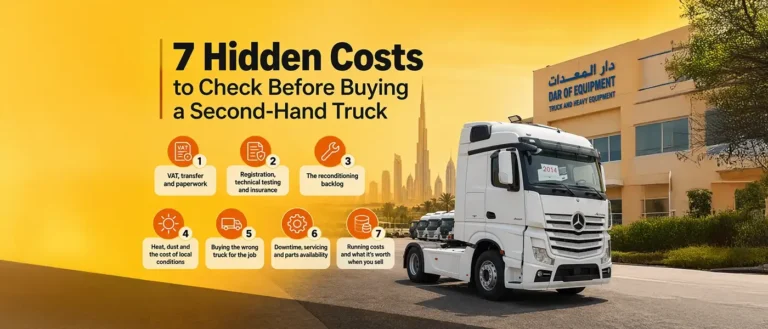
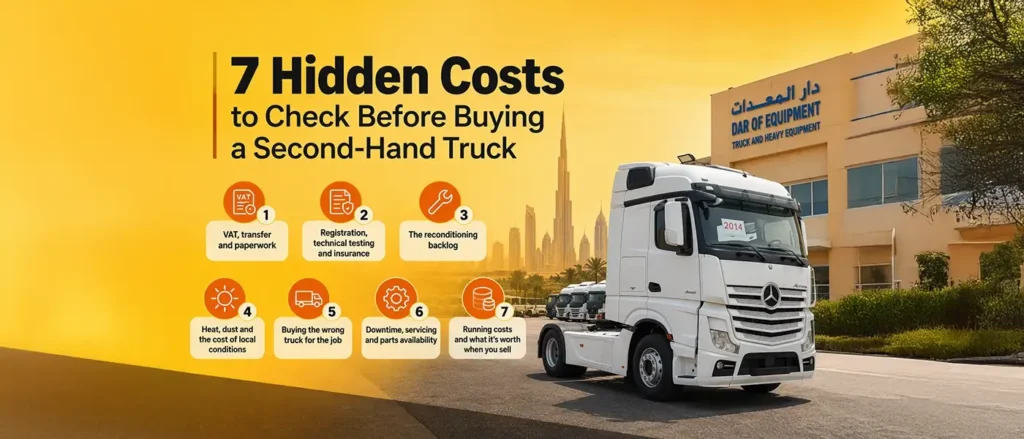
If you’re searching for a second hand truck for sale in Dubai, the sticker price is only the first number in a longer calculation. This guide covers the seven costs that most often catch buyers out, and how to check each one before you commit.
Why the listed price is only the starting point
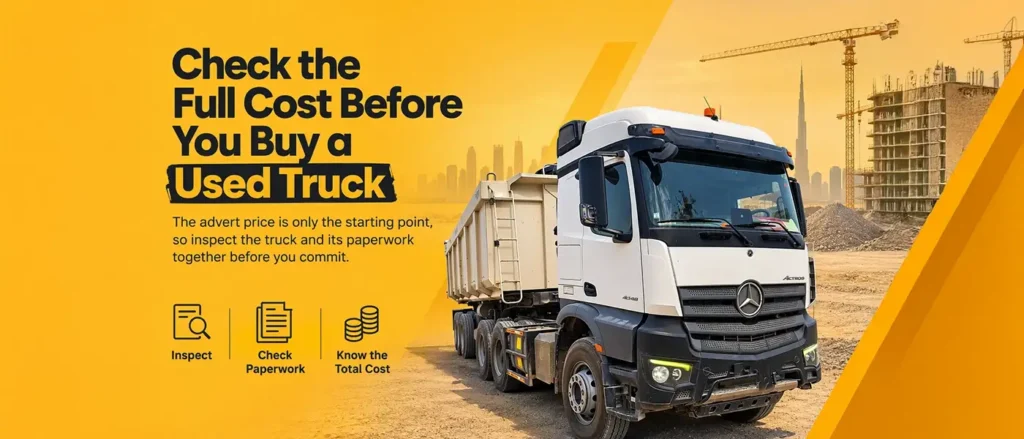
Searches for used trucks for sale in Dubai and heavy truck price in Dubai return a wide spread of prices. That’s normal. Make, age, mileage, body type, condition and service history all move the number. What listings rarely show is the total cost of getting a truck legally on the road and working profitably.
Think of it in layers:
| Layer | What it covers |
| Purchase price | The figure in the advert |
| Getting it road-ready | VAT, transfer, registration, testing, insurance |
| Getting it work-ready | Repairs, tyres, fitting out for the job |
| Keeping it working | Servicing, parts, fuel, downtime |
| Getting out of it | Resale value, or switching to rental |
The seven costs below sit mostly in layers two to five.
1. VAT, transfer and paperwork
Quick answer: check whether the quoted price includes VAT, and who pays ownership transfer fees.
UAE VAT is 5%, and dealer prices are often quoted before VAT. On a heavy truck, that’s a meaningful sum. Buyers who treat the headline figure as the final one get a surprise at the invoice.
Paperwork matters just as much:
- Confirm the truck’s ownership documents are in order.
- Ask whether any traffic fines are outstanding against the vehicle. Fines can block registration renewal until they’re cleared.
- Find out who handles and pays for transfer.
A reputable dealer will explain all of this before you sign. A seller who gets vague about it is telling you something.
2. Registration, technical testing and insurance
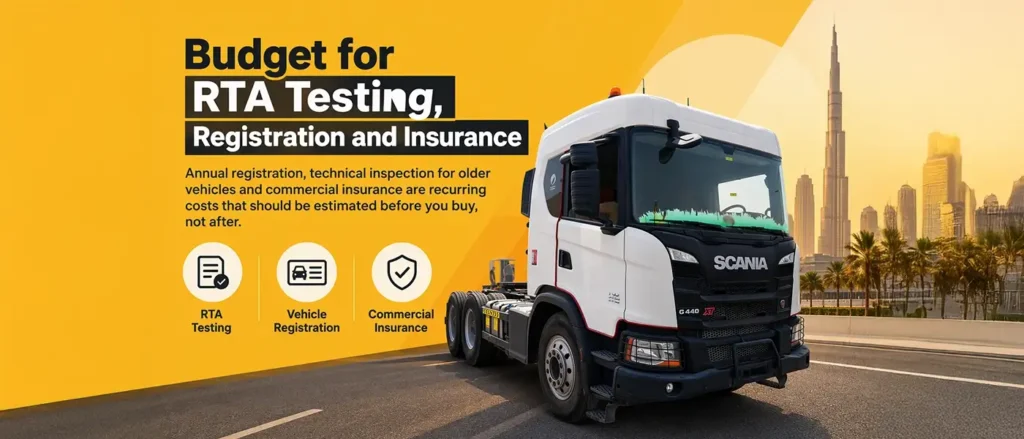
A truck in Dubai needs valid registration (the Mulkiya), and that’s renewed every 12 months through the RTA. Vehicles more than three years old generally need to pass a technical inspection before renewal, and heavy vehicles carry higher test and registration fees than light ones.
Fees vary by weight category and change over time, so check the current RTA schedule rather than relying on a figure from an old article. Booking an inspection appointment online has also been mandatory in Dubai, so factor in the time as well as the money.
Insurance is the other recurring cost. Commercial and heavy vehicle premiums depend on the truck’s age, type, value and how you use it. Get a quote before you buy, not after.
Expert tip: an older truck may be cheaper to buy, but it may also face tougher testing and higher insurance. Ask for a rough annual compliance cost alongside the price.
3. The reconditioning backlog
Here’s the cost that catches most buyers: the work the previous owner put off.
Some used trucks arrive freshly serviced. Others arrive with worn tyres, tired brakes, a slipping clutch, leaking hoses or a battery on its last legs. Each one is a small bill. Together, they can rival the discount you thought you’d negotiated.
Before buying, ask for:
- The full service history (and be sceptical when there isn’t one)
- A recent inspection report covering engine, gearbox, brakes, suspension and axles
- A list of what has been replaced recently, and what hasn’t
The question that saves money: “What will this truck need in the first six months?” A seller who answers honestly is worth more than one who says “nothing.”
4. Heat, dust and the cost of local conditions
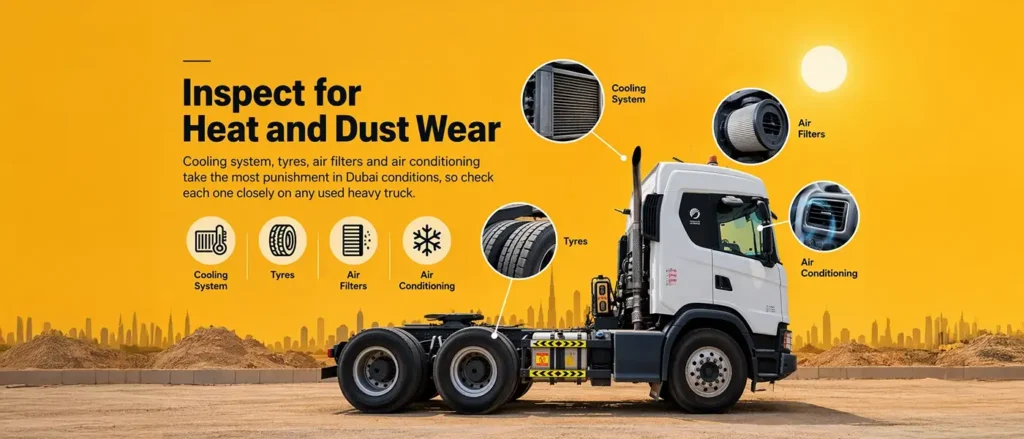
Trucks in Dubai work hard in conditions that wear them faster. High temperatures stress cooling systems, tyres, batteries and air conditioning. Fine dust clogs filters and gets into everything. Trucks that have worked in desert or construction environments often show it.
When you inspect a used heavy truck, pay special attention to:
- Cooling system: radiator condition, hoses, fan operation, any history of overheating
- Tyres: age and wear pattern, not just tread depth, since heat degrades rubber over time
- Air filters and intake: signs of heavy dust ingestion
- Air conditioning: a failed system isn’t only a comfort issue; operators work badly in heat, and it affects safety
A truck that’s spent years in harsh site conditions may still be a good buy. It just needs a price and a maintenance plan that reflect it.
5. Buying the wrong truck for the job
A truck that’s cheap but wrong for the work is the most expensive purchase of all.
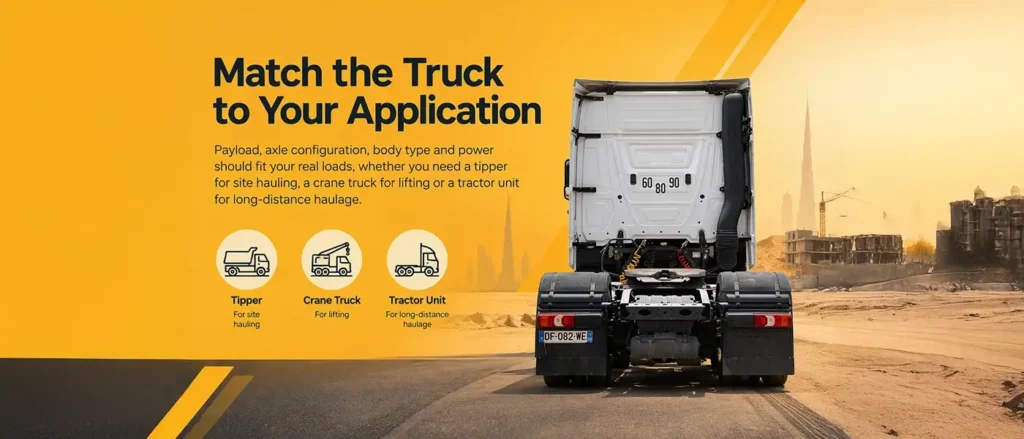
Payload, axle configuration, body type, engine power and gearbox all need to match how you’ll use it. A tipper suited to site hauling isn’t the same as a chassis built for a crane, and neither suits long-distance haulage. Converting or fitting out a truck afterwards adds cost, and sometimes it simply can’t be done properly.
Overloading is the related risk. A truck regularly run beyond its rated capacity wears out faster and creates compliance problems. If your real loads are heavier than the truck’s rating, a lower price doesn’t make it a bargain.
| If your job is… | Ask about… |
| Site hauling and earthmoving | Tipper body condition, axle count, payload |
| Lifting and delivery | Crane rating, chassis strength, outriggers |
| Long-distance haulage | Fuel efficiency, tractor unit, gearbox |
| Mixed, changing work | Flexibility, or whether renting makes more sense |
This is where expert consultation pays for itself. Describing your actual application to someone who knows the equipment can narrow the choice quickly and avoid a costly mismatch.
6. Downtime, servicing and parts availability
A truck that’s cheap to buy but slow to repair costs money every day it’s parked.
Ask three questions about any used truck:
- Can I get parts locally? Popular makes with strong dealer networks are easier to keep running than rare ones.
- Who will service it? A workshop that knows the brand shortens repair times.
- What happens when it breaks down? Lost working days are a cost, even when no one sends an invoice.
For a business, a day of downtime can cost more than the repair. That’s why brand support and parts supply deserve a place in the buying decision, next to price and mileage.
7. Running costs and what it’s worth when you sell
Fuel is usually the biggest ongoing expense after the purchase itself. An older engine can burn noticeably more than a newer one over a year of daily use, and that difference adds up. Ask about typical consumption for the model, and about extras such as AdBlue where the truck uses it.
Resale matters too. Trucks with full service records, popular specifications and clean paperwork hold their value better. Trucks with gaps in their history are harder to sell, and buyers discount accordingly. Think about the exit when you buy, not when you sell.
Before you buy, consider renting first
Not every project justifies a purchase. If the work is short-term, seasonal or you’re still unsure which truck suits the job, rental is worth considering. It lets you test a specification on a real project, avoid maintenance and compliance costs, and defer the buying decision until you know what you need.
Buying makes more sense when the truck will work most days, the application is stable and you have a plan for servicing it.
Your quick pre-purchase checklist
- Is VAT included in the quoted price?
- Are ownership papers clear and fines cleared?
- Have you estimated registration, testing and insurance?
- Do you have the full service history and an inspection report?
- Have you checked cooling, tyres, AC and filters?
- Does the specification match your real loads and application?
- Are parts and servicing available locally?
- Do you know the likely fuel use and resale position?
Choose a Truck Built for How You’ll Use It
The best deals on a second hand truck for sale in Dubai aren’t the cheapest ones. They’re the ones where the price, condition, specification and support all add up.
If you’re weighing used trucks for sale in Dubai, comparing used heavy trucks for sale in Dubai, or unsure whether to buy or rent, talk to the team at Dar of Equipment. They can offer expert consultation, help match quality used equipment to your application, and explain the rental options if buying isn’t the right move yet.
Visit www.darofequipment.com to get in touch, and tell them what you’ll be hauling, where and how often.
Talk to an expert before you buy
- 📞 Phone: 04 832 1114 or +971 50 336 3519
- 📧 Email: info@darofequipment.com
- 📍 Visit: 56-57 Truck Market and Auto Spare Parts, Al Ruwayah, Dubai, UAE
Frequently Asked Questions
It varies widely with make, age, mileage, body type and condition. Treat the listed price as the starting point and add VAT, registration, insurance and any repairs to find the real cost.
Check the service history, inspection report, cooling system, tyres, brakes, gearbox and paperwork. Also confirm there are no outstanding fines and that the specification suits your work.
UAE VAT is 5%, and it commonly applies to dealer sales. Confirm in writing whether the quoted price includes it.
Vehicles older than three years generally need to pass an RTA technical inspection before registration renewal. Check the current requirements for your truck’s category before you buy.
Rent if the work is short-term, seasonal or uncertain. Buy if the truck will work regularly and you can plan for maintenance and compliance.
Match payload, axle configuration, body type and power to your actual loads and conditions. Talking through your application with an equipment specialist before you buy helps avoid a mismatch.
Not necessarily. A lower purchase price can be offset by higher repair, fuel and compliance costs. Compare the total cost over the time you’ll own it, not only the price.